Prev
None
APAO 2026: Red light therapy moves into the global spotlight - Insight
The 41st Asia-Pacific Academy of Ophthalmology (APAO) Congress, held on 5–8 February 2026 in Hong Kong, marked a defining moment for repeated low-level red light therapy (RLRL) in myopia management, according to Eyerising International.
The company said that since its introduction in 2021, RLRL had generated considerable discussion and research. At APAO 2026, it reported the therapy was featured across more than 20 abstracts, presentations and symposia spanning paediatric and adult populations, monotherapy and combination therapy, laser safety testing and mechanistic studies.
Eyerising said the congress delivered several key developments, including longer-term data extending beyond three years, multi-ethnic evidence beyond Asian cohorts, a comprehensive evaluation of the laser safety profile of RLRL, and the launch of a clinician-led society intended to establish consensus and support global implementation of the therapy.
APMS symposium: light therapy takes centre stage
According to Eyerising, the Asia-Pacific Myopia Society symposium on innovative light therapies was a major focus early in the congress.
Chaired by Professors Ian Morgan and Kathryn Rose, the session brought together speakers to discuss the efficacy, safety and mechanism of RLRL.
Eyerising reported that Professor Mingguang He presented updated three-year real-world data from China (n=362). Rates of “good control” (defined as <0.10 mm/year axial elongation) were said to remain high across treatment durations, ranging from 89% at 6–12 months to 82.2% at 2–3 years and 72.5% at three years and above, with an average of 0.06mm/year.
The company said a comprehensive safety assessment showed no functional decline in visual acuity or ffERG changes, with four transient ellipsoid zone irregularities on OCT resolving after RLRL discontinuation.
Eyerising also reported that Professor Kyoko Ohno-Matsui, with later independent presentations by Dr Naoki Isamura and Dr Junfuku Lee, presented data on RLRL in highly myopic children and adults. The company said the adult data showed both axial shortening and choroidal thickening after two months of treatment.
According to Eyerising, Professor Haidong Zou discussed a study of RLRL in highly myopic children that demonstrated a stronger effect than in moderate myopia. The session concluded, the company said, with Professor Jason Yam announcing a 23-centre international RLRL randomised controlled trial launched in late 2025 to provide multi-ethnic safety and efficacy data.
IRLOS launch: from data to governance
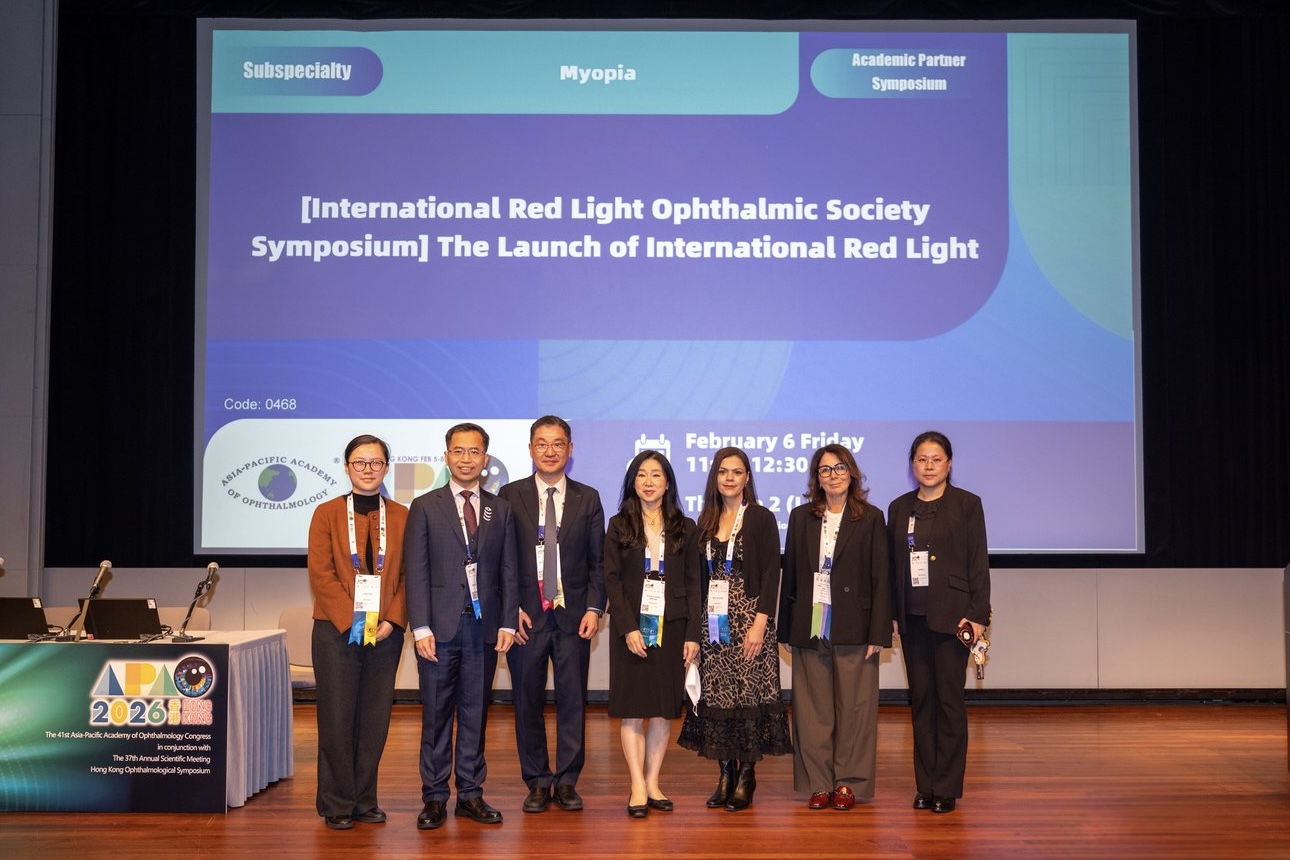
Eyerising said a major milestone of APAO 2026 was the formal launch of the International Red Light Ophthalmic Society (IRLOS).
The company described IRLOS as a clinician-led initiative aimed at establishing consensus standards, supporting responsible implementation of RLRL and providing evidence-based educational resources.
Opening remarks were delivered by Professor Ningli Wang, followed by presentations from Professors He and Yam outlining the organisation’s vision and structure, according to Eyerising.
The company said Emeritus Professor John Marshall presented a laser safety evaluation of an RLRL device, concluding there was negligible hazard risk when used as intended.
According to Eyerising, Professors Junwen Zeng and Ni Zhang discussed real-world RLRL use and mechanistic concerns, while Dr Loren Rose and Dr Nellie Deen presented Australian experiences, including real-world prescribing and a randomised controlled trial at the Australian College of Optometry.
Eyerising said the launch of IRLOS signalled a shift toward professional governance as the therapy expands globally, with consensus guidelines expected to follow.
Beyond symposia: key moments at APAO
Elsewhere at the congress, Eyerising reported the first European randomised trial combining RLRL with orthokeratology. The company said the study demonstrated mean axial shortening and improved myopia control compared with orthokeratology alone.
It also cited a randomised controlled trial comparing RLRL to 0.01% atropine, which it said reported significantly less myopia progression in the RLRL group (0.02–0.04mm/year) than in the atropine group (0.32–0.34mm/year).
The company further reported mechanistic analyses suggesting posterior pole flattening in RLRL-treated eyes, indicating a possible structural effect at the scleral level.
Looking at real-world use, Eyerising said its device is now available in several countries outside China. It cited a multinational analysis of more than 1,000 patients on RLRL, reporting a mean compliance level of 80.7% – highest in Japan at 85.3%, and averaging 65–75% in Western markets.
Eyerising said the body of evidence presented at APAO 2026 indicated a transition for RLRL from an emerging therapy toward more mainstream use, with IRLOS expected to play a key role in guiding safe and effective implementation.